
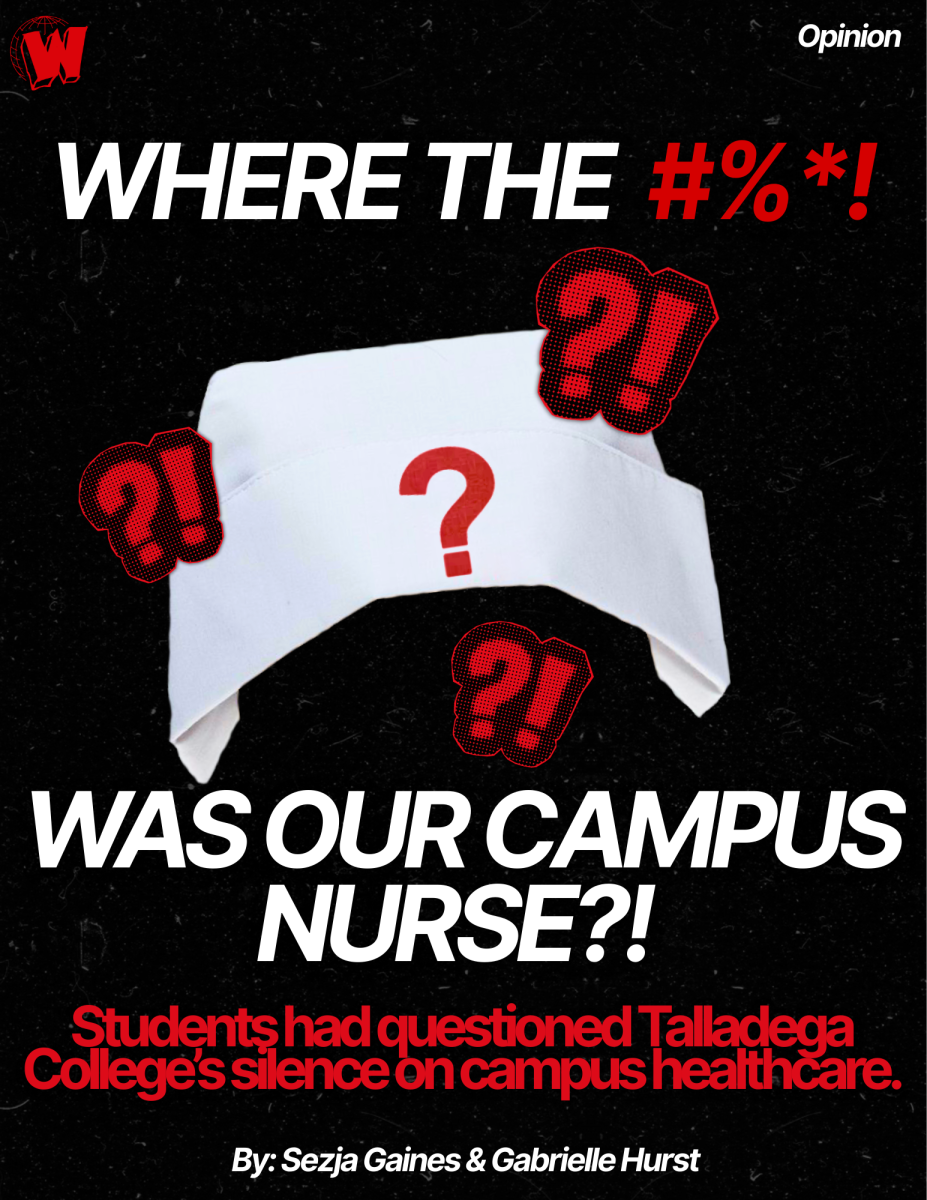





This article serves as a follow-up to “Where Was Our School Nurse.” During the last semester, an outbreak of COVID-19 spread throughout residence halls and dorm rooms. The situation was worsened by the absence of a school nurse to distribute COVID tests, issue pardons from classes, or provide formal diagnoses to students. In October, the institution hired a medical assistant; however, she was reportedly unavailable in her office for students seeking care for non-emergent illnesses. Additionally, the medical assistant left before the end of the semester without notice to students. These challenges are compounded by the rural location of Talladega College, where the nearest hospital is approximately one hour away and the local medical center charges $120 or more for students without insurance.
Talladega College students voiced their concerns through a survey published by The Wall 627. Students were asked whether they believed having an on-campus health professional is imperative. One hundred percent responded that it is. This response raises ongoing questions about why the issue remains unresolved and why adequate solutions have not been implemented. When asked whether their medical needs are being met on campus, 75 percent responded no. Additionally, 50 percent indicated that insurance is not included in their institutional fees. These responses suggest that students are aware of what they are paying for and feel they are not receiving corresponding services.
Students were also asked, “How do you feel about the lack of a healthcare professional on campus?” One student responded, “I feel as though the lack of an on-campus health professional severely limits what students can do health-wise. If they are sick or injured, they have to shell out hundreds of dollars for urgent care or emergency medical services.” Another stated, “The absence of a healthcare professional on campus is deeply concerning and, honestly, unacceptable. Colleges and universities are responsible not only for students’ academic growth but also for their overall well-being. Failing to provide on-campus healthcare overlooks the reality that many students rely on campus as their primary, and sometimes only accessible, source of medical support. Without a healthcare professional available, students facing illness, injury, or mental health concerns are left to navigate complex healthcare systems on their own, often during already stressful situations. This issue is especially troubling when considering that not all students have reliable transportation, health insurance, or the financial resources to seek care off campus. Some students may not own a car, may depend on limited public transportation, or may be balancing jobs and coursework that make traveling to off-campus clinics difficult. For these individuals, the lack of on-campus healthcare creates a significant barrier to receiving timely and necessary treatment. Ultimately, a campus without accessible healthcare sends the message that student health is secondary. In reality, academic success and personal well-being are closely connected. If institutions are committed to supporting their students holistically, ensuring the presence of qualified healthcare professionals on campus should be viewed not as a luxury but as a fundamental responsibility.”
Students were then asked what could be done in the interim while the institution searches for a healthcare professional. One student responded, “I think the school needs to be transparent with the students about what is being done, rather than leaving us lost and confused. Additionally, I do not think students should be penalized for absences without doctor’s notes, because at this time it is not entirely feasible to get one.” Another suggested establishing formal partnerships with nearby clinics or hospitals, implementing telehealth services, improving transportation support, providing emergency-response training for staff, and maintaining transparent communication about the hiring process.
The Wall 627 reached out to the institution for comment and was informed that a nurse and a telephysician have been hired to serve students. This information was provided by Dr. Xavier Whitaker, Vice President of Student Affairs. The Wall 627 does not yet have additional details about these hires but is working to obtain and publish that information.
The Wall 627 also contacted the Talladega Health Department, which redirected inquiries to the Alabama Department of Public Health. As of publication, no response has been received.
While this is not an isolated issue, institutions in rural areas have faced similar or even more severe circumstances when lacking on-campus healthcare services. At Tuskegee University, a 21-year-old student from Conyers, Georgia, passed away following a sudden and unexpected medical emergency on campus. Tuskegee University declined to comment when asked about its on-campus health services.
As the spring semester continues, students remain concerned about consistent access to healthcare and transparent communication from administration. The availability, reliability, and accessibility of medical services on campus remain central to the broader question of student well-being and institutional responsibility.