





Dating Then vs. Now at Talladega College
One of the many interesting things I noticed during Homecoming was the number of couples who came together, with most of them meeting while they were here at Talladega College. This is not a surprise because “college romance” has been a common phenomenon until recently. So why are people not dating and getting married from college anymore? Is this a Dega thing?
There are a number of reasons we can point to.
Firstly, social media has changed the way we experience relationships. Couples now overanalyze online behavior — who posted who, who liked what, who viewed a story but didn’t respond. While social media does not define a relationship, it can heavily influence how secure someone feels in it. It also provides easier access to cheating, secrecy, and comparison to unrealistic online standards.
Secondly, there is a growing fear of commitment. Whether students are focused on personal growth, extracurricular involvement, career goals, or simply unsure of what they want, many find situationships, extended talking stages, and undefined connections easier to manage than fully committing to a titled relationship.
Third, there seems to be an overemphasis on sex. With explicit content and pornography more accessible than ever, sex is often prioritized before emotional intimacy. Physical attraction can take precedence over building depth, patience, and vulnerability, making hookups easier to pursue than serious relationships.
Lastly, there is a clear lack of communication. In a digital world where texting dominates, many type more than they talk. Tone is misread. Screenshots replace conversations. Add in a fear of confrontation, and misunderstandings grow without resolution.
More specifically to Dega, some students do not want to be involved with each other because it is a small campus and they feel like if the relationship ends, they have their business out there. Because social circles are small, things can get messy quickly.
The irony lies in the fact that everybody is complaining about being lonely. We see it in Instagram reposts and anonymous messages on Fizz. Students say relationships are hard, yet hesitate to simply approach someone in person.
But things weren’t always so complicated.
When Love Was Simpler: Alumni Reflections
For Karla and Russell Holloway, love quite literally began on “the wall.” Now approaching 54 years of marriage, their story is deeply rooted in Talladega tradition — a legacy that runs even deeper, as Karla’s parents were also Degan sweethearts.
As first-year students, women would line up along the wall (the side closer to Foster Hall) while upperclassmen “grilled” them with questions about school history and traditions. Russell was, in Karla’s words, a “master harasser.” She thought he was annoying — but she noticed him. He thought she was cute. They were both right.
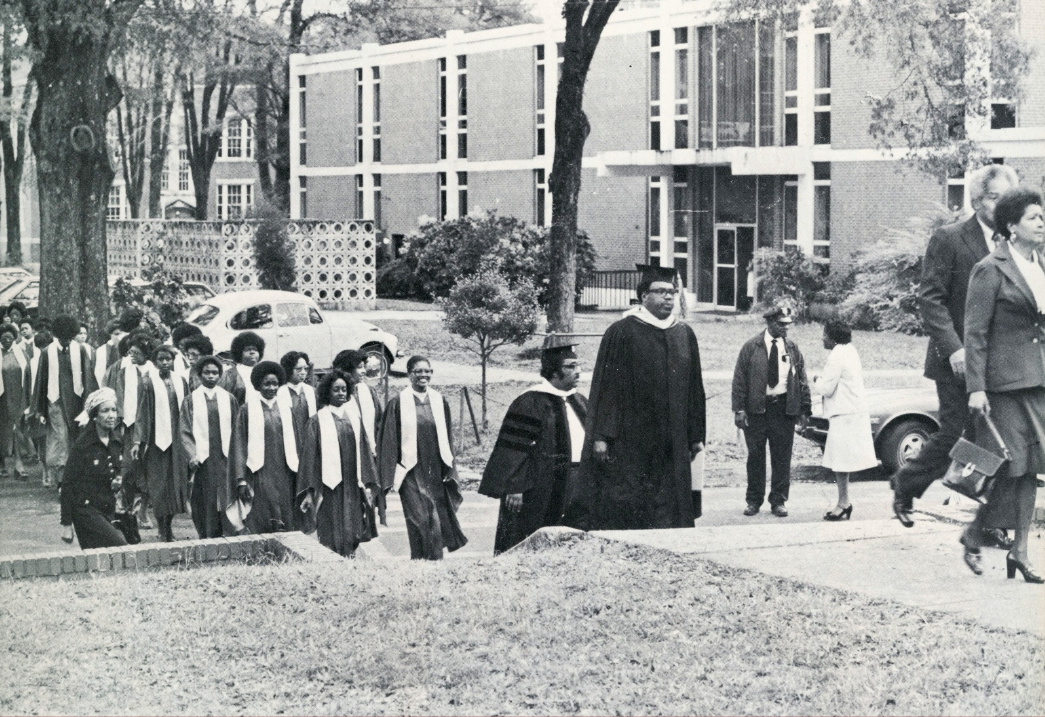
Dating looked different then. If someone came to see you, your name would echo through the dorm lobby — “you have a caller.” You would descend the staircase while your friends leaned over the balcony to see who it was. Couples strolled campus openly. When the streetlights came on, boys crossed back to their side. Romance was intentional, visible, and built through real conversation — not notifications.
Another Talladega love story belongs to Jessica and Daryl Grice, the current operators of the on-campus TC Spirit Store. They met in August 1993 on the front porch of Fanning Hall (The Cafe).
In their words, he was interested. She was interested.
They played video games in the downstairs pub, spent time on the wall, at Swayne Hall, and in the library. There was no social media. “It forced us to talk,” they reflected. Dating meant late-night bologna and cheese sandwiches, falling asleep on the phone, and spending time together simply because they wanted to — not for status or clicks.
More than 30 years later, they are still together, with two children and two grandchildren. Talladega brought them together — and kept them together.
The Current Reality: What Students Are Saying
To understand what dating looks like now, 68 students responded to a survey.
- 52.9% women, 47.1% men
- 83.8% straight, 16.2% bi/pansexual
- 58.8% currently single
- 41.2% currently in a relationship
- 50% have dated someone on campus
- 79.4% said they are not engaging in casual sex
- 86.8% have been in a serious relationship before
When asked how big of an impact money has on relationships (1–5 scale), most students selected 3 (36.8%), suggesting finances matter — but are not everything. When asked how much sex matters in a relationship, most students ranked it in the middle — suggesting it’s important, but not the foundation. Still, a notable portion ranked it highly, showing that physical intimacy remains a significant factor in campus relationships.
Student responses revealed recurring themes: cheating, dishonesty, immaturity, fear of commitment, and communication breakdowns. Several students said “serious dating is hard, but hookups are easy.” Others mentioned mental health struggles and the difficulty of maintaining privacy on a small campus where “everyone knows everyone.”
Still, not all perspectives were negative. Some students said dating isn’t hard if you find someone who matches your energy. Others described love as “a journey, not a popularity contest.”
Current Couples: Making It Work
Despite the challenges, some students are building intentional relationships.
Gabrielle Hearst (Junior, Birmingham, AL) & Jordan Frazier (Senior, Memphis, TN)
Together for a year and four months, they met through Instagram in the summer before finally meeting in person one August night on campus. They have met each other’s families and sometimes travel to see each other over breaks.
Dating in college, they admit, is not easy. Balancing 18 credit hours, a full-time job, mental health challenges, and extracurricular commitments can be overwhelming.
Their biggest obstacles? Time and emotional balance.
Their solution? Communication, patience, and planning ahead — especially during holidays and long breaks.
After graduation? They plan to stay together.
Yasmine McGee (Junior, New Orleans, Louisiana) & Anteresa “Tete” Dickson (Junior, Memphis, Tennessee)
Together for 2 years and 5 months, Yasmine and Tete met during Freshman Orientation week at Talladega College. They have met each other’s families and have navigated both shared and separate holidays.
They describe dating in college as challenging because they are “still finding ourselves and growing every day.”
Yasmine notes that competing priorities — classes, work, organizations, friendships, and future plans — can strain a relationship.
Tete adds that busy and opposite schedules are often the biggest obstacle.
What keeps them grounded? Trust, mutual respect, and communication.
As for what happens after graduation? They plan to continue growing together.
Closing
So the question remains: is dating in college actually worth it?
Well, much like most Degans’ dating lives — it’s complicated.
College is meant for learning, growth, and earning your degree. But within those four years, love, dating, sex, and relationships are almost inevitable. You are meeting new people, discovering who you are, and figuring out what you want — and sometimes that process includes someone else.
So is it worth it?
It can be — if you are open, honest, emotionally mature, and clear about your goals and intentions. It can be worth it if you are willing to grow, to communicate, and to learn your partner as much as you learn yourself.
And for those who may not want to commit so soon — that is fine too. Not everyone is in the same place. The key is clarity. As long as all parties are honest about what the situation actually is, no one is left guessing, assuming, or getting hurt over undefined expectations.
At the end of the day, dating in college is not a popularity contest, a performance for social media, or a race to marriage. It is simply another part of the human experience — one that can teach you about boundaries, vulnerability, accountability, and self-awareness.
Whether you choose commitment, casual connection, or complete focus on yourself, move intentionally. Speak up for yourself. Be honest about what you want. And most importantly, give yourself grace while you figure it out.
Because maybe love at Dega isn’t gone.
Maybe it just looks different.